

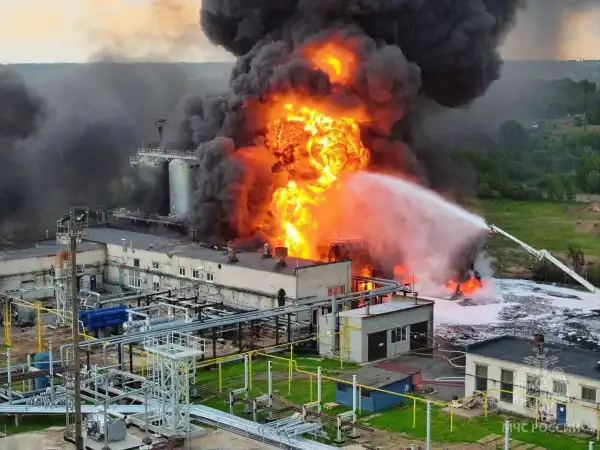
Ukrainian strikes are increasingly reaching deep into Russian territory, with air raid alerts now being recorded in almost half of the country’s regions, writes Bloomberg.
According to the publication, in the last week alone, missile danger warnings were announced in at least five regions of the Volga Federal District, in southern areas, including Astrakhan, as well as in at least four regions of the North Caucasus. Similar signals were also heard in central Russia – in the Moscow, Vladimir, Tambov, Oryol, and Lipetsk regions.
Analysts note that the geographical scope of the alerts demonstrates a significant shift in the nature of Ukrainian strikes and an expansion of their range. If previously air raid alerts were mostly confined to border regions, they now encompass much deeper areas of Russia.
According to Bloomberg, this year regions inhabited by over 70% of the Russian population have announced a missile alert at least once.
Drones reach everywhere
The emergence of threats in previously remote regions is being recorded separately. In particular, the Omsk region in Western Siberia, almost 3000 kilometers from the Ukrainian border, announced a missile alert for the first time in June. Similar signals also extended to the Ural region.
In several cities, the consequences of attacks are already affecting civilian life. For example, in Samara, ground public transport was temporarily halted during one of the alert signals.
Consequences of strikes on Russian infrastructure are also reported. In the Voronezh region, five people died after one of the attacks, and in the Volgograd region, two died. Additionally, a fire continues at an oil refinery in the Krasnodar Krai following a massive drone attack.
Ukraine has changed its strategy
Ukraine is increasingly utilizing long-range drones and missiles of its own production, including “Neptune” and “Flamingo.” According to open sources, their range can reach from 1000 to 3000 kilometers, allowing them to strike targets in a significant portion of Russia’s European territory.
Military analysts note that such strikes have not only a military but also an economic and psychological effect.
“Ukraine often tries to saturate Russian air defense with drones so that cruise missiles can penetrate it,” said Sam Cranny-Evans, a military analyst at the Royal United Services Institute in London.
Douglas Barrie, a senior fellow at the International Institute for Strategic Studies, also believes this represents a qualitative change in the nature of the campaign:
“This marks a significant evolution in Ukraine’s long-range strike campaign.”
According to him, strikes on Russian infrastructure “damage elements of the industrial military base, hit the economy, and show the population that the war has a price.”
Reading now: G7 summit in France: Trump changed his position on Russia, – Bloomberg.
Why you can trust vesti-ua.net →
